
Bitcoin Network Activity Erupts After Iran Peace Deal: Is The Bottom In For BTC?
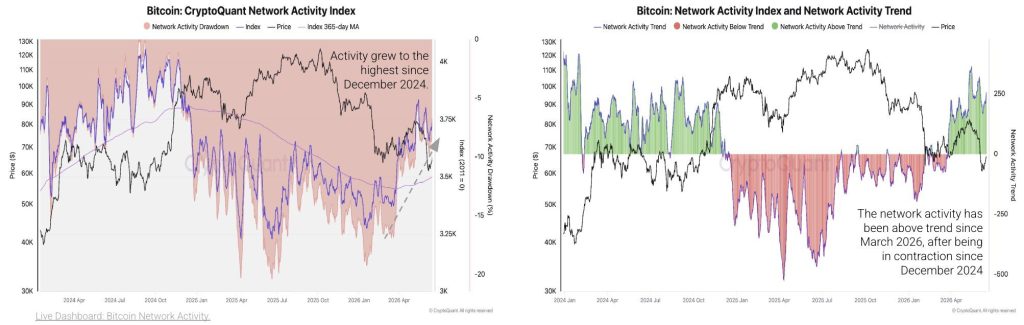
Bitcoin network activity index crossed above its 365-day moving average for the first time since December 2024, entering what CryptoQuant research news officially classifies as a bull phase, the same threshold that preceded significant price advances in 2024 and 2025.
Daily Bitcoin transactions have exceeded 800,000 in 2026, more than doubling from 2025 lows, and the network activity index has jumped from roughly 3,320 to approximately 3,600. BTC price at time of writing sits at $62,500, down 2.5% over 24 hours.
The timing carries macro weight. Partial de-escalation from the Iran peace deal has removed some of the geopolitical risk premium that had been suppressing risk appetite across crypto markets, with BTC holding just above the 200-week SMA near $62,000, a level that has historically functioned as long-cycle support.

The combination of a bull-phase network signal and a macro tailwind makes the bottom question legitimate. What the data actually shows, however, is more complicated than the headline implies.
Strip out the price action, and something structurally notable is happening underneath. Whether it is signal or noise is the entire question.
Discover: The Best Token Presales
Bitcoin News: On-Chain Activity, What the 365-Day MA Break Actually Tells Us
CryptoQuant’s network activity index measures a composite of transaction count, active addresses, and block utilization.
Breaking above its 365-day average has historically marked the transition into sustained bull-phase behavior, it happened in late 2024 and again briefly in April 2025, both of which preceded upward price moves. The index is now in that band again for the first time in over a year, with average transactions per block running near record levels for several consecutive weeks, which CryptoQuant describes as structural rather than transient.
The accumulation data reinforces the signal. Long-term holders, the so-called HODL-oriented cohorts, now hold more than 4.37 million BTC, up from roughly 2 million BTC in early 2024.
That is a meaningful illiquid supply lock-up that historically tightens available float ahead of price recoveries. VanEck’s analysis shows roughly 43% of supply dormant for more than three years, in the upper percentiles historically.
The caveat is direct: CryptoQuant said “the economic content of these transactions differs materially from prior high-activity periods.” Transactions below 0.01 BTC, roughly $630 at current prices, now account for approximately 80% of all daily on-chain activity, up from 44% in 2023.
The surge in the sub-0.001 BTC and sub-0.01 BTC cohorts toward their previous 2024 highs is being driven almost entirely by OP_RETURN-based protocols: Runes, Ordinals, BRC-20 tokens, and data timestamping services.
CryptoQuant noted OP_RETURN usage has “spiked to near-record levels in 2026,” with these protocols generating large volumes of dust-value microtransactions that “directly explain the low-value cohort surge.” The transferred value per transaction, as the firm put it plainly, “is tiny.”
The mempool has expanded to approximately 128,000 pending transactions, its highest level since late February 2025, with congestion concentrated in the low-fee tier. CryptoQuant warns that sustained expansion of protocol-driven activity “could drive fee increases for time-sensitive economic transactions,” which would eventually impose real costs on genuine economic throughput. That dynamic is worth tracking, but it is not yet at the threshold where it meaningfully disrupts settlement flows.
Discover: The Best Token Presales
The post Bitcoin Network Activity Erupts After Iran Peace Deal: Is The Bottom In For BTC? appeared first on Cryptonews.